Kettle Springs Volunteer Fire Department
Clown in a CornfieldThe Kettle Springs Volunteer Fire Department is depicted through a small number of public emergencies rather than through its internal organization. Its firefighters have already helped put out a fire at the Baypen factory, damaging a pump engine in the process; at the Founder’s Day parade, they must respond amid fireworks, confusion, and a collision that continues even as they try to control the immediate danger. The department’s significance lies in this contrast: the town can praise its volunteers, but their work depends on equipment that may not be ready when another crisis arrives.
Service and Local Standing
The department’s reputation is voiced in the aftermath of the factory fire. Cole Hill admits that he made a mistake and says he is not sorry the boarded-up factory is gone, while Janet Murray corrects his claim that it has disappeared: the interior may have burned, but the structure is still standing. Ronnie Queen then praises the volunteer firefighters, connecting their competence to the response that brought the fire under control. Her remark offers a moment of recognition amid the group’s argument about the damage. It also makes the department’s service tangible: the fire is not merely part of the factory’s destruction but an emergency that required local volunteers to act.
That response has a material cost. At a public meeting about whether to cancel Founder’s Day, Fred Vassar objects that the pump engine was damaged while firefighters were putting out the fire at the Hill boy’s property and will not be ready for the parade. His concern turns praise for the department into a question of capacity. The same intervention that demonstrates the volunteers’ usefulness has left a central piece of equipment unavailable, while another speaker immediately raises the possibility of a further fire. The scene does not establish what resources the department has beyond this engine, but it clearly shows the practical vulnerability created when emergency work damages equipment needed for subsequent duties.
The Founder’s Day Parade Emergency
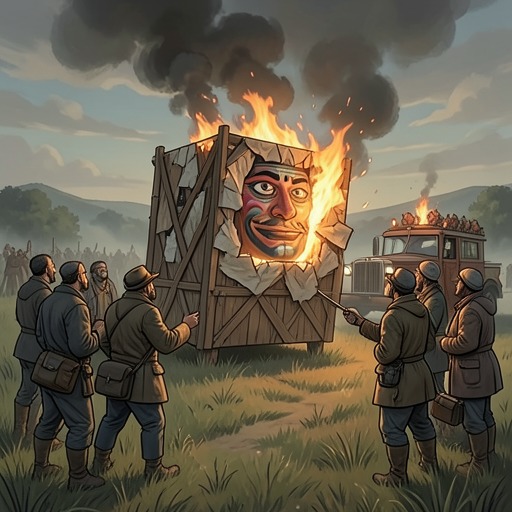
During the parade, the department encounters an unfolding situation whose early signs are difficult to interpret. Sparks erupt from the corners of a platform carrying a giant ear of corn, and more whistles and pops sound farther down the block. The firefighters look to one another, bewildered, unsure what to do. The crowd, by contrast, initially treats the sparks and snaps as part of the entertainment, while Quinn Maybrook recognizes that they are not part of the official program. In this gap between what the crowd expects to see and what is actually happening, the volunteers’ uncertainty becomes part of the danger: the disturbance is not immediately legible as an emergency to either the firefighters or the spectators.
When the corn float is burning, firefighters use extinguishers on it and work quickly. Their effort is real and directed, but their attention is concentrated on the visible fire. Behind them, a slow-motion wreck continues: the third float, carrying Cub Scouts on a large fish, rear-ends the truck. The scouts cry, some stumble or fall from the platform, and the crowd watches helplessly. More fireworks pop and hiss down the street, adding noise to an already chaotic scene. The department’s response therefore has two simultaneous aspects: firefighters act against the flames, yet the collision and its risks persist outside their immediate focus. The episode presents neither a simple failure nor a fully controlled rescue; it shows emergency work under conditions in which several hazards develop at once.
Equipment, Limits, and Narrative Role
The earlier damage to the pump engine gives the parade episode a practical background. At the meeting, residents had worried that the engine would not be ready for the parade and that the town might face another fire without it. The parade then supplies a different kind of test: fireworks, a burning float, displaced riders, and a continuing vehicle wreck crowd the same street. The evidence does not say whether the damaged engine is used during the parade, so the earlier concern cannot be treated as a direct explanation of the firefighters’ actions there. Instead, the two scenes together emphasize how volunteer service is exposed to both equipment damage and unpredictable emergencies.
The department also occupies a narrow but important position in the parade’s changing mood. The sparks first read as spectacle, prompting amusement rather than alarm; once the floats collide and children are thrown off balance, the celebratory scene becomes visibly dangerous. Firefighters move from bewilderment to using extinguishers on the corn float, while the larger crash continues behind them. Their presence makes the town’s dependence on local emergency response visible without making them the sole force shaping events: the equipment, moving floats, fireworks, crowd, and delayed recognition all contribute to the crisis. Through that shift, the department is shown as necessary and active, but not omnipotent.